
THE SPIRIT ACCOUNTABILITY REPORT
Real Numbers. Real Data. — Issue 01
A note before we start: this issue runs longer than usual. That’s not padding — it’s what real accounting looks like when every figure gets traced back to its source instead of a repeated headline number. We’d rather ask a few extra minutes of your time than get it wrong.
Since Spirit shut down flight operations at roughly 3:00 a.m. ET on May 2, 2026, close to 17,000 people have been trying to get what they’re owed out of an estate that’s still spending millions of dollars a month on the lawyers and advisors managing its own unwinding. We’ve spent the last few weeks pulling the actual filings — not summaries of summaries — before putting numbers in front of you. Here’s where things stand, sourced to the docket!
1. The Wage Pool vs. The Executive Incentive Plan
In May, the Debtors asked the court to approve $10.7 million in retention payments — a Key Employee Retention Plan, or KERP — for 130 non-senior-management employees who agreed to stay on through the wind-down. Payments average roughly $76,000 per person. That part is straightforward: it’s real, it’s capped at $10.7 million, and it’s the workforce’s.
Running alongside it is a separate incentive structure for three people: the CEO, the general counsel, and the CFO. Per the transcript of the June 12 hearing on the plan, the cash portion comes to $1.9 million split between the three of them — on top of a percentage of asset sale proceeds and 4% of whatever the wind-down saves in costs. Unlike the workforce’s $10.7 million, those last two components don’t have a fixed ceiling; they scale with how the sale goes.
Separate from both of these, and worth not confusing with the KERP: the DIP financing order established a carveout specifically for employment-related claims — unpaid wages, accrued vacation and sick pay, WARN Act liability — capped at $80 million. The Debtors have funded roughly $70 million of that into segregated accounts so far. That’s the pool the 17,000 people who lost their jobs on May 2 are actually drawing against for what they’re owed.
(Sources: Hearing transcript, Docket 1233; Objection/Supplement to Wind-Down Motion, Docket 1164.)
2. What One Quarter of Professional Fees Looks Like
We pulled the Third Interim Fee Applications — covering March 1 through May 31, 2026 — for the estate’s four lead professionals. Each figure below traces to a specific docket entry.
Firm Role Fees + expenses, this quarter Davis Polk & Wardwell Lead counsel to the Debtors $12,275,723.73 FTI Consulting Restructuring advisors $7,697,587.61 Debevoise & Plimpton Fleet counsel to the Debtors $2,818,007.40 PJT Partners Investment banker $676,314.59 (flat monthly advisory fee, not hourly)
Total: roughly $23.5 million billed by four firms in the same 13 weeks the estate was arguing over a $70 million cap on what it owes the people it laid off.
One honesty note: this is one quarter’s figures, not a running total since the case began in August 2025. We don’t yet have verified First and Second Interim figures for three of these four firms, and we’d rather hand you an airtight number for one period than a guessed-at total for the whole case. We’re tracking down the earlier applications and will update this if the fuller picture changes anything materially.
Note: Debevoise & Plimpton’s actual court-filed title is “Fleet Counsel to the Debtors and Debtors in Possession” — not “Special Fleet Counsel” or “Special Aviation Counsel” as earlier drafts had it.
3. What “Restructuring Advisory” Actually Buys
FTI’s own fee application breaks its work into task categories — and one of them is titled, verbatim, “PR and Media Monitoring”: $160,716.50 in fees across 229.3 hours, for this quarter alone. In FTI’s own description, the work included assessing media reactions to case developments, tracking coverage trends, preparing weekly monitoring summaries, responding to press inquiries on the Debtors’ behalf, and working to keep public coverage aligned with the company’s account of events.
Three specific line items from that exhibit, checked against the filing itself:
April 22, 2026 — FTI Senior Managing Director Rachel Chesley billed 0.2 hours ($246) for a call with CEO Dave Davis to discuss media and social media sentiment.
Same day — Chesley billed 1.7 hours ($2,091) to triage inbound media inquiries and pursue corrections following a leak.
May 15, 2026 — FTI Senior Consultant Jonah Pitkowsky billed 0.6 hours ($354) to prepare an update on the payroll situation specifically for reporters.
(Source: Docket 1339, Exhibit F-2 — FTI Consulting’s Third Interim Fee Application.)
A note from our end, separate from the court record: we can’t tell you what specifically drove FTI’s monitoring hours — we only have their billing description, not their internal reasoning. What we can tell you is that more than half of all traffic to this campaign’s website over its life has been attempted intrusions rather than readers. Between professionals billing by the hour to track what’s being said about this case, and people trying to break into the site saying it, this campaign has clearly drawn attention from every direction — the people it’s for, the firms being paid to watch it, and the people trying to take it down.
We’ll let that sit.

4. What’s Actually on the Table — and When
Per the Debtors’ asset schedules, filed November 18, 2025 (these are net book values as of that filing — not current market or auction value, and likely to have shifted with sales and lease rejections since):
Owned aircraft: $1,367,098,954.66
Spare engines: $564,991,709.41 — note: earlier drafts cited “$167 million in unencumbered parts inventory.” We can’t reconcile that figure against the schedules we have; $565M appears to be the full book value of all spare engines, encumbered or not. Treating the $167M figure as unverified pending a check of which specific assets are pledged as collateral.
Dania Beach headquarters campus (four owned buildings on Radiant Drive): $278,605,012.68 combined book value for buildings, land, and leasehold improvements. This replaces the $250M and $154M figures used in earlier drafts — we couldn’t trace either of those to a source in the schedules.
LaGuardia airport slots: carried from earlier drafts at approximately $86.7 million; not yet independently verified against the docket.
Confirmed hearing schedule
Date Time (ET) What’s happening July 22, 2026 11:00 a.m. Sale Hearing — matters relating to the sale of the Debtors’ assets August 4, 2026 10:00 a.m. Next scheduled sale-related hearing
The July 22 time is corrected from an earlier 10:00 a.m. reference in earlier drafts — the most recent scheduling notice on the docket (filed July 13, Docket 1310) sets it at 11:00 a.m., and it’s the latest word on the point.
Other bid deadlines carried over from earlier drafts are still being checked against the current docket before this goes out — the schedule has moved at least twice already as objections got resolved, so we’re being careful here.
5. The Fight Over What’s Left
Two very different bids are in front of the court for what remains of Spirit.
Harlem Park Partners, run by pro se filer Ameer Flippin, has been pushing to acquire Spirit’s trademarks, goodwill, and the Spirit.com domain. His own filing with the court (Docket 1331) documents email correspondence with PJT Partners and FTI Consulting, and a reply from Davis Polk’s Christopher Robertson — that exchange is now part of the public record, though we’re still reading through the full filing before characterizing exactly what it shows about data-room access.
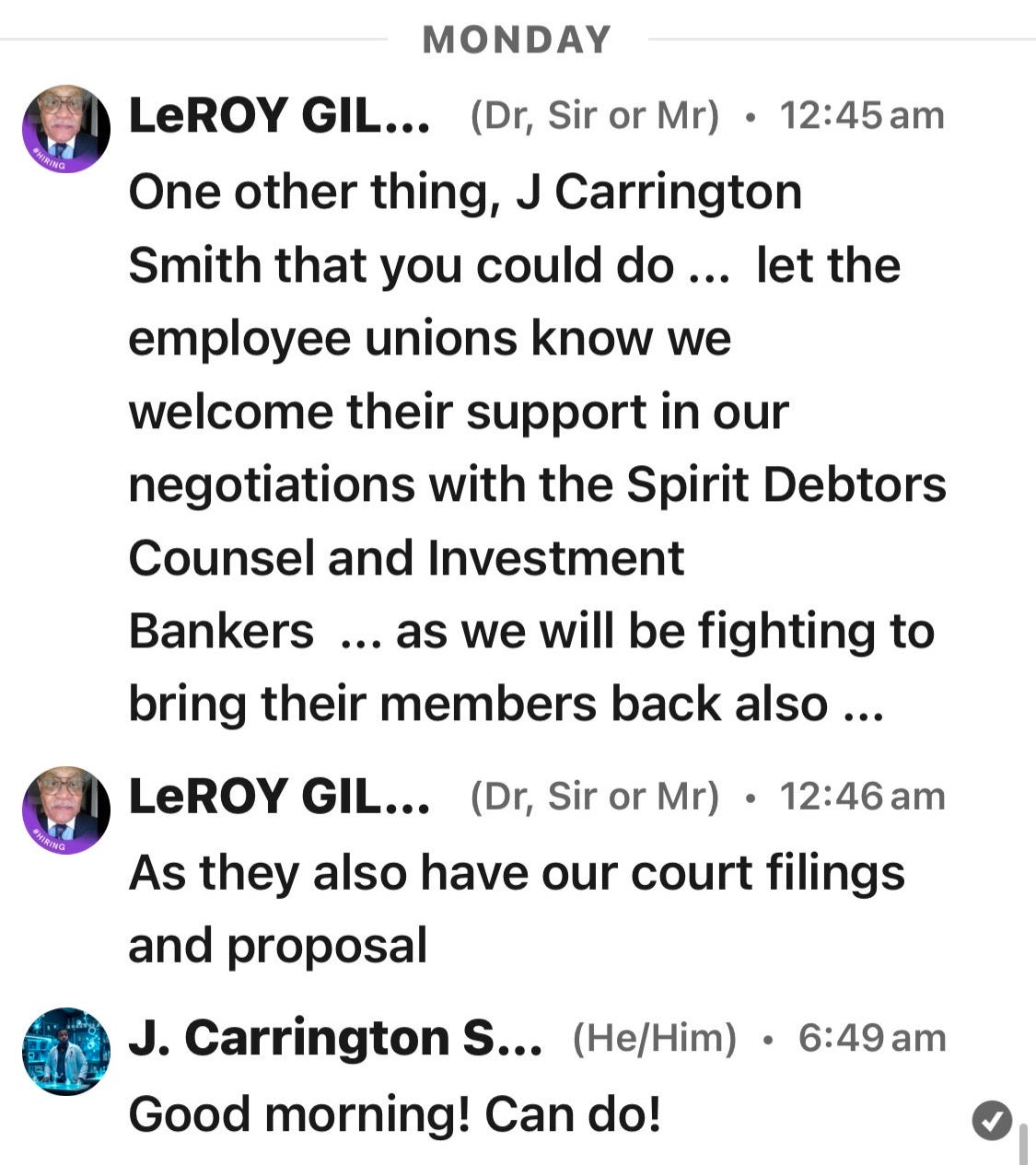
Florida Air Express (FAE), led by LeRoy Gillead II, has put forward a “debt-for-equity” proposal to take over Spirit’s operations assets — a going-concern structure aimed at keeping the workforce intact rather than a piecemeal sell-off. In a message to this newsletter, Gillead confirmed FAE filed the proposal with the bankruptcy court and also sent it directly to Spirit’s investment bankers, in case Debtors’ counsel didn’t pass it along. As of this week, FAE says it’s still waiting to hear back on the transaction, even as the court-ordered liquidation process has already begun. Gillead has said publicly he’d rather let the filed pleadings speak for FAE’s position for now and isn’t making further personal statements while that process plays out.
Gillead also specifically asked that this newsletter pass a message along to Spirit’s unions: FAE welcomes their support in its negotiations with Debtors’ counsel and the investment bankers, since — in his words — FAE will be “fighting to bring their members back also.” He noted the unions already have FAE’s court filings and proposal in hand. We’re passing that along as requested. We can’t independently verify what happens next on that front — only that the ask was made directly to us, and we agreed to relay it.
6. Where the Unions Stand
ALPA secured a dedicated wind-down fund covering pilots’ vacation pay, sick leave, and 401(k) contributions. AFA sits on the Unsecured Creditors Committee and has publicly pressed the administration for specific relief on members’ behalf — including prioritizing payment of earned wages, extending flight attendants’ healthcare, and coordinating hiring with other carriers. What hasn’t happened yet, as far as the public record shows, is a matching wind-down fund for flight attendants or a public position from AFA on the FAE proposal specifically.
Ground crew has a stake in this too. The IAM, which represents Spirit’s ramp service agents, has publicly called on the bankruptcy court and the administration to prioritize worker pay over executive compensation. Together with TWU Local 570 — which represents Spirit’s guest service agents, not dispatchers or mechanics — IAM filed a Limited Objection to the Debtors’ KEIP and KERP motion. They weren’t alone: ALPA filed its own separate Limited Objection to the KEIP, and the U.S. Trustee filed a Supplemental Objection of its own, all on the docket ahead of the June 10 hearing.
None of it changed the outcome. The court didn’t rule that day — it set a further hearing for June 12 specifically to issue a bench ruling, and that’s the same hearing this newsletter’s KERP and executive-incentive figures come from. Every objecting party was on the record, and the plan was approved essentially as proposed. We don’t yet have the objections’ own arguments or a specific union representing Spirit’s dispatchers or mechanics — nothing we’ve found identifies one.
What We’re Asking This Week
Watch the July 22 Sale Hearing — 11:00 a.m. ET.
If you’re owed wages, vacation, or sick pay, get your claim logged: https://spiritdidnotpayme.com/take-action/. The record needs to reflect everyone affected, not just the people who happen to see this newsletter.
If you’re a union member, ask your local where things stand on the FAE proposal and what it would take to get public backing behind it.