The unions’ description of what Spirit’s motion would mean for former employees: they “are not entitled to a cent of the DIP funds.” (IAM, TWU Local 570 and ALPA, Doc. 1586, Pg 2, ¶3)
Two things happened since Issue 014. A congressional letter landed on the data sale, and the paperwork behind the Carve-Out B fight finally got read. Nothing has been decided in court, and the next hearing is Wednesday, October 14.
A Correction on the Carve-Out B Numbers
Issue 014 said Carve-Out B was “originally $80 million.” That was wrong. The DIP order sets an $80 million cap, and the Official Committee of Unsecured Creditors says the account was funded with $70 million, with about $58 million remaining (Doc. 1592, Pg 1 of 4, ¶1). AFA’s objection quotes the cap and says, on information and belief, that about $70 million was deposited (Doc. 1591, Pg 6 of 21, ¶¶12-13). The $58 million figure is the Committee’s, not a number Spirit has put in a sworn filing that I have seen.
Congress Weighed In on the Data Sale
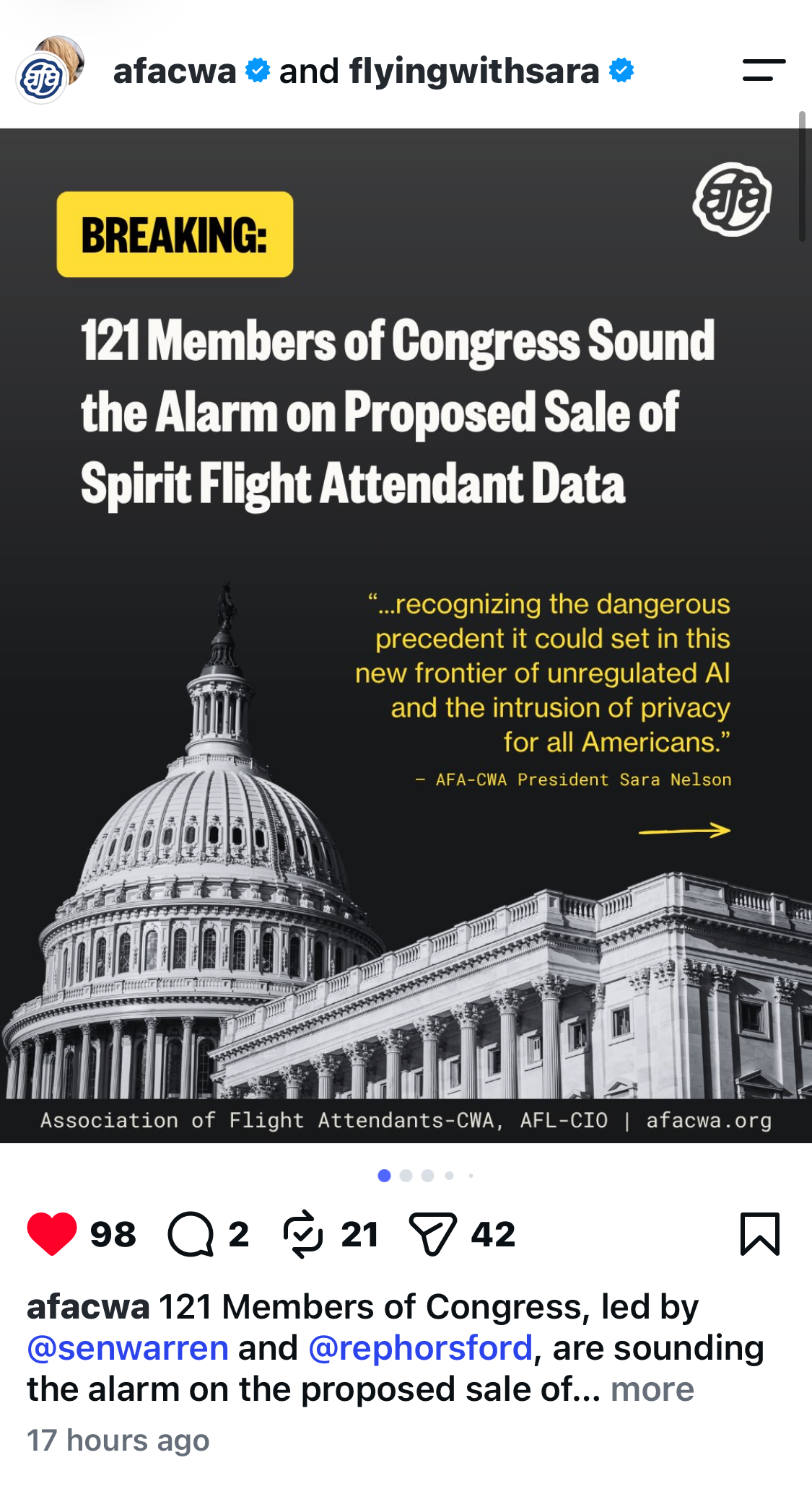
On October 8, AFA announced a letter to Google CEO Sundar Pichai and Spirit CEO Dave Davis, led by Sen. Elizabeth Warren and Rep. Steven Horsford and signed by 121 members of Congress (13 senators and 108 House members), according to the letter AFA posted at afacwa.org. It asks that employee information be excluded from the sale as much as possible, and at minimum training records, timecards, payroll information, and Microsoft 365 content containing flight attendant information. It also asks for a de-identification protocol built with input from affected workers, an independent review of employee-related data before any transfer, and exclusion of voluntary safety-program data (fatigue management, ASAP, FOQA, LOSA). It asks that nothing employee-related move until protections are in place.
Two limits worth knowing. This is a letter to two companies, not a court filing, and it does not bind Judge Lane. And its figures (about 100 million emails and 500 million Teams messages) are attributed in the letter to “publicly available court findings”; I have not matched them to a docket entry.
I also haven’t found independent press coverage of the letter yet.
What the Consumer Privacy Ombudsman Did and Did Not Look At
On October 5 the court’s Consumer Privacy Ombudsman, Lucy L. Thomson, filed a supplemental report (Doc. 1684). She recommends that, from a privacy perspective, approving the sale “would be appropriate” (Pg 3 of 9).
That is about passengers: passenger transaction, refund, in-flight purchase and WiFi systems are now excluded from the sale (Pg 5 of 9), and Spirit has hired Tonic.ai as the deidentification agent (Pg 3 and Pg 6 of 9).
The part that matters to the ~17,000 of you: she states twice, in footnotes, that she “did not investigate or reach any conclusion about whether the data offered for sale or the deidentification process to be followed presents any risks to affected employees or third parties” (Pg 3, fn. 3, and Pg 6, fn. 9). She also notes the list of excluded systems is still “subject to change,” though any system designated as excluded “will remain excluded” (Pg 5, fn. 8). Her report doesn’t answer the employee-privacy question. That question is still with AFA, ALPA, APA and the court.
One thing to point out: considering the amount of data, the novelty of this case, and the constant influx of new events, this is not unusual. M(r)s. Thomson simply needs more time to thoroughly review the information to make a decision.
What Employees and Their Lawyers Told the Court About Carve-Out B
Three objections to Spirit’s motion to release the Carve-Out B money (Doc. 1541) were never covered here. I do not have the motion itself in my files, so Spirit’s position below is as described in these filings.
The proposed class (Doc. 1575, filed Sept. 8). The WARN Act plaintiffs say the motion rests on one premise, that “all such liabilities have been paid in full,” and that Spirit filed no declaration or payment records to support it (Pg 6 of 24, ¶¶1-2). They point to Spirit’s own wind-down supplement, which says “no amounts will be paid on account of any values related to WARN, unused vacation or unused PTO” (Pg 7, ¶3), and to a sworn declaration from named plaintiff Susana Rios, a New Jersey flight attendant, who says she has received no payment since her final paycheck, including nothing under the New Jersey WARN Act (Doc. 1575-1, Pg 2 of 3, ¶¶4-5). They add that about 1,300 former employees are non-union, so the Railway Labor Act argument does not touch them (Pg 8, ¶6; Pg 19, ¶31). They ask the court to deny the motion or at least keep the account funded until their case is decided (Pg 23, ¶39).
AFA (Doc. 1591, filed Sept. 9). AFA’s argument is procedural and broad. It says Spirit is asking the court to rule on the rights of thousands of employees who were never named or served, and that this cannot be done by a motion (Pg 2-3, ¶¶3-4). AFA says it does not necessarily oppose a ruling between Spirit and its lenders on whether the contract conditions for releasing the account are met (Pg 2, ¶2). If the court grants anything, AFA asks that it be limited to the money question and preserve every employee’s direct claims (Pg 4, ¶8).
IAM, TWU Local 570 and ALPA (Doc. 1586, filed Sept. 9). The unions say Spirit is asking the court to confirm that “the bulk” of former employees, including all those IAM and TWU represent, “are not entitled to a cent” of these funds (Pg 2, ¶3). Their footnote says pilots’ New Jersey WARN claims were paid because that law carries personal liability for executives, and that “no pilots have been paid other amounts owed” (Pg 2, fn. 2). They ask the court to adjourn or deny the motion (Pg 3, ¶7).
Yes, you read that right. Based on the findings from three employee unions, the Spirit Estate is essentially saying it owes nothing to its former employees.
The Committee’s own statement is the closest thing to a signal. It agrees the union contracts alone don’t create personal liability, but says non-union employees may have claims, and it “encourages the Debtors and the DIP Lenders to engage with the employee unions and non-union former employees” to settle (Doc. 1592, Pg 2-3, ¶¶3-4). It also says it understands that only New Jersey WARN obligations have been paid from the account (Pg 2, ¶1). That is the Committee’s understanding, and it is the exact point Ms. Rios’s declaration disputes.
Still No Date for Carve-Out B
I checked every filing from October 2 through 7 (Docs. 1681-1691). None sets a new Carve-Out B hearing date. The last word is still Doc. 1662: the hearing “has been adjourned,” with no date (Pg 1 of 2). The money has not moved.
Legal Fees So Far…
Morris Nichols, Spirit’s conflicts counsel, requested $82,149.94 for July (Doc. 1681, Pg 1 of 22).
Morris Nichols requested $70,093.70 for August (Doc. 1682, Pg 1 of 16).
Jefferies, the Committee’s investment banker, filed its final fee application asking for $3,778,054 for the whole case: $3,650,000 in fees plus $128,054 in expenses (Doc. 1689, Pg 1-2).
Hearing on the Jefferies application is set for November 17 (Doc. 1689, Pg 1).
Bottom Line
The Carve-Out B money is about $58 million, not $80 million, and it has not moved. Employees and their lawyers have put sworn evidence and legal arguments in front of the court, and nobody has ruled. On the data, Congress has asked for employee protections, but the court’s own privacy ombudsman has told the judge she did not examine employee risk. I’ll report what happens October 14.
Upcoming Court Dates
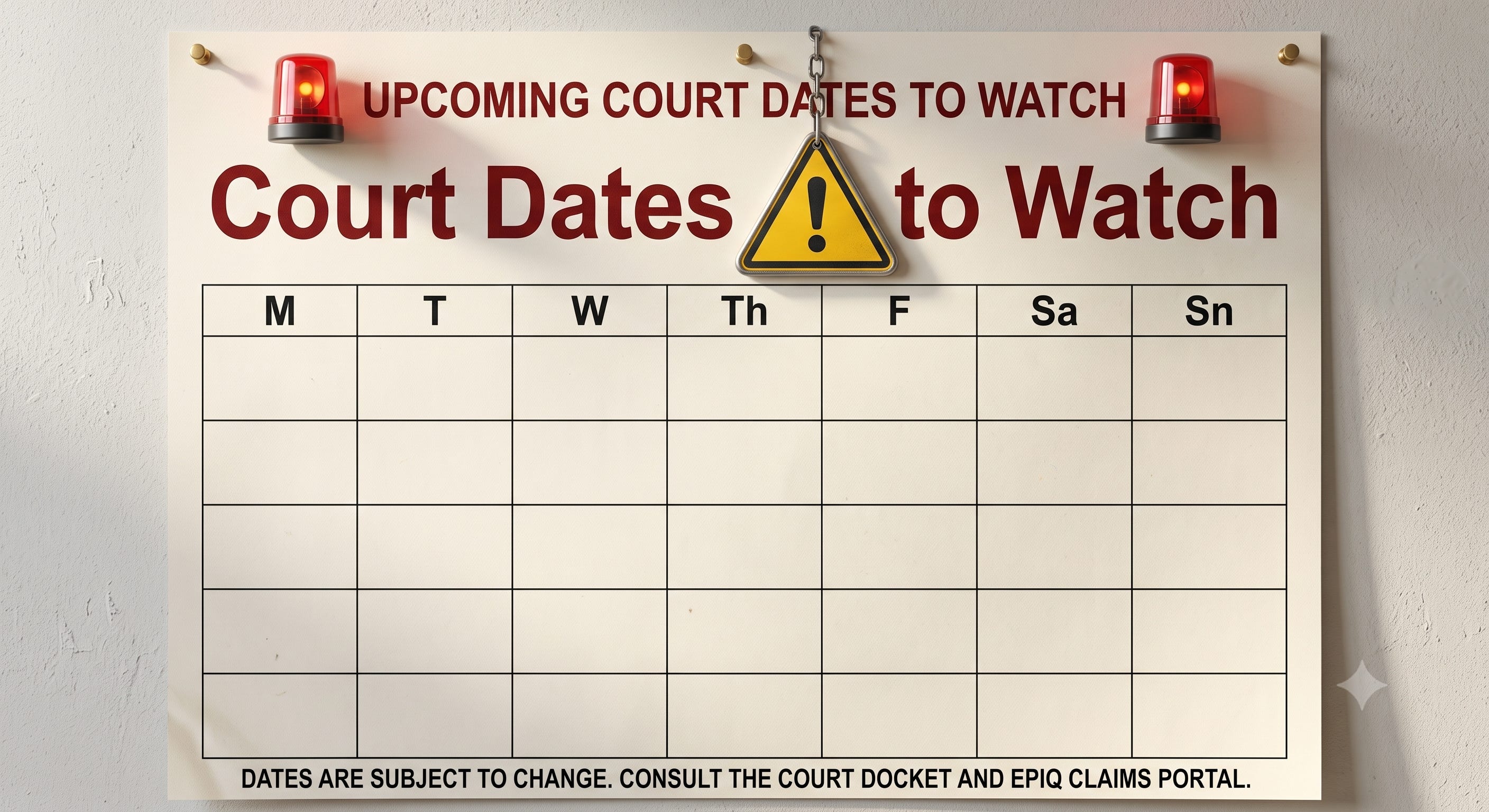
October 14, 11:00 a.m. — Data sale hearing (hybrid)
October 14 — CSDS escrow hearing; Eversheds Sutherland retention hearing
October 28, 4:00 p.m. — Objection deadline, Jefferies final fee application
November 17, 11:00 a.m. — Hearing, Jefferies final fee application
Carve-Out B hearing — adjourned, no new date set
— The Unpaid Employee | spiritdidnotpayme.com