The Bar Date Has Passed. Here’s What That Means.
July 27, 2026 at 11:59 p.m. came and went — the deadline for filing Pre-Wind Down Administrative Expense Claims is now behind us. If you filed, individually or through your union, that part is done. If you didn’t, we’ll talk in a future issue about what options (if any) remain.
For this issue, we’re shifting focus to where the real fight is happening right now: how the Omnibus Union Claims work and the surprisingly different paths AFA, ALPA, IAM/TWU, and PAFCA have each taken with them, the WARN Act lawsuit, and the $70 million sitting in a segregated account that nobody — yet — has been paid from. We’re also flagging a privacy issue in the claims system that you need to check on your own filing, and laying out the court dates coming up in August, September, and October.
How the Omnibus Union Claim Actually Works
A lot of members have asked what it means that their union “already filed a claim” for them. Here’s the mechanics, straight from the court’s own order (Docket 1215, signed June 22, 2026):
AFA filed a single claim covering the whole Flight Attendant bargaining unit. Rather than requiring every flight attendant to individually navigate the claims portal, the court’s order authorized “each of the Unions” to file one collective claim — an “Omnibus Union Claim” — on behalf of the employees it represents (Docket 1215, p.4). AFA used this mechanism for Flight Attendants. Other unions in the case appear to have handled things differently — ALPA, for instance, advised pilots not to file individual claims while it worked through its own process — so if you’re not AFA-represented, it’s worth confirming directly with your own union which route it actually took.
Filing it counts as full compliance with the bar date. If your union’s omnibus claim covers you, you did not need to file your own separate claim to preserve your rights to the wages and benefits it includes.
The claim has to do specific things. Under the order, each Omnibus Union Claim must identify covered members to the extent known, lay out the legal basis for the claims (CBA violations and WARN Act violations specifically), specify dollar amounts where calculable — marking anything uncertain as unliquidated or contingent — and be filed against Spirit Airlines, LLC as the employing entity.
One nuance worth knowing: AFA actually ran a three-track process rather than a single filing. AFA filed an omnibus prepetition claim back when the case began in August 2025, then a separate WARN Act/CBA notice claim on May 23, 2026, and then this newest Pre-Wind Down omnibus claim tied to the July 27 bar date. If you’re trying to trace what’s covered where, that’s the shape of it.
If you filed an individual claim in addition to your union’s omnibus filing — like several of us did, to make sure our specific numbers weren’t lost in an averaged, unit-wide estimate — both are now on file and will be considered separately.
How the Unions Split: Four Different Fights Over the Same Money
Every certified union had the same tool available under Docket 1215. What each one did with it looked very different.
AFA — the aggressive outlier. Rather than waiting on the standard bar-date timeline, AFA filed a standalone request for payment of administrative claim as early as May 24, 2026, forcing an early review of Flight Attendants’ wage claims. AFA also filed a comprehensive objection to the Debtors’ Supplement to the Wind-Down Motion (Docket 1164), directly targeting the exculpation and release language meant to shield Spirit’s executives from personal liability for unpaid wages. AFA is, so far, the only union that has formally invoked the Supreme Court’s Harrington v. Purdue Pharma decision in this case, arguing the Debtors can’t use exculpation clauses to extinguish employees’ rights to pursue the $70 million in segregated employee accounts.
ALPA, IAM, and TWU — targeted objections, plus public pressure. The pilots’ union and the ground crew unions took a narrower legal approach: limited objections (Dockets 1163 and 1166) aimed specifically at the executive bonus (KEIP) structure. They won language in the final KEIP order barring executives from earning bonuses off “cost savings” that come from not paying employee claims, and argued that any employee-related payments carved out under the DIP order should be paid at the same time as management’s incentive payments.
ALPA also took the fight outside the courtroom. In a June 4, 2026 op-ed, ALPA National President Jason Ambrosi wrote directly to the bondholder group controlling the wind-down fund — naming Citadel, PIMCO, Cyrus, Western Asset Management, AllianceBernstein, Arena Capital Advisors, and Ares Management Corp. by name — arguing that pilots who stayed through the shutdown and gave up $85 million in pay and retirement concessions shouldn’t be treated as “a convenience that expired the moment they were no longer useful.” He pointed to what the delay actually costs: one Spirit pilot now interviewing at a major carrier is facing a 57 percent pay cut, and Florida’s unemployment benefit tops out at $275 a week — nowhere close to covering a family’s bills during a job search that can take the better part of a year. Read the full piece on LinkedIn.
PAFCA — a minimal footprint. The dispatchers’ union didn’t file any written objections to the wind-down, the executive bonuses, or the exculpation provisions. At the June 12, 2026 hearing, PAFCA’s counsel appeared only to confirm on the record that no filing had been made on the union’s behalf. Despite the light touch, PAFCA dispatchers remain fully covered under the same Docket 1215 omnibus framework as everyone else.
Different strategies, same underlying fight: getting money out of accounts the bondholders currently control.
The WARN Act Fight: Where Dionne v. Spirit Stands
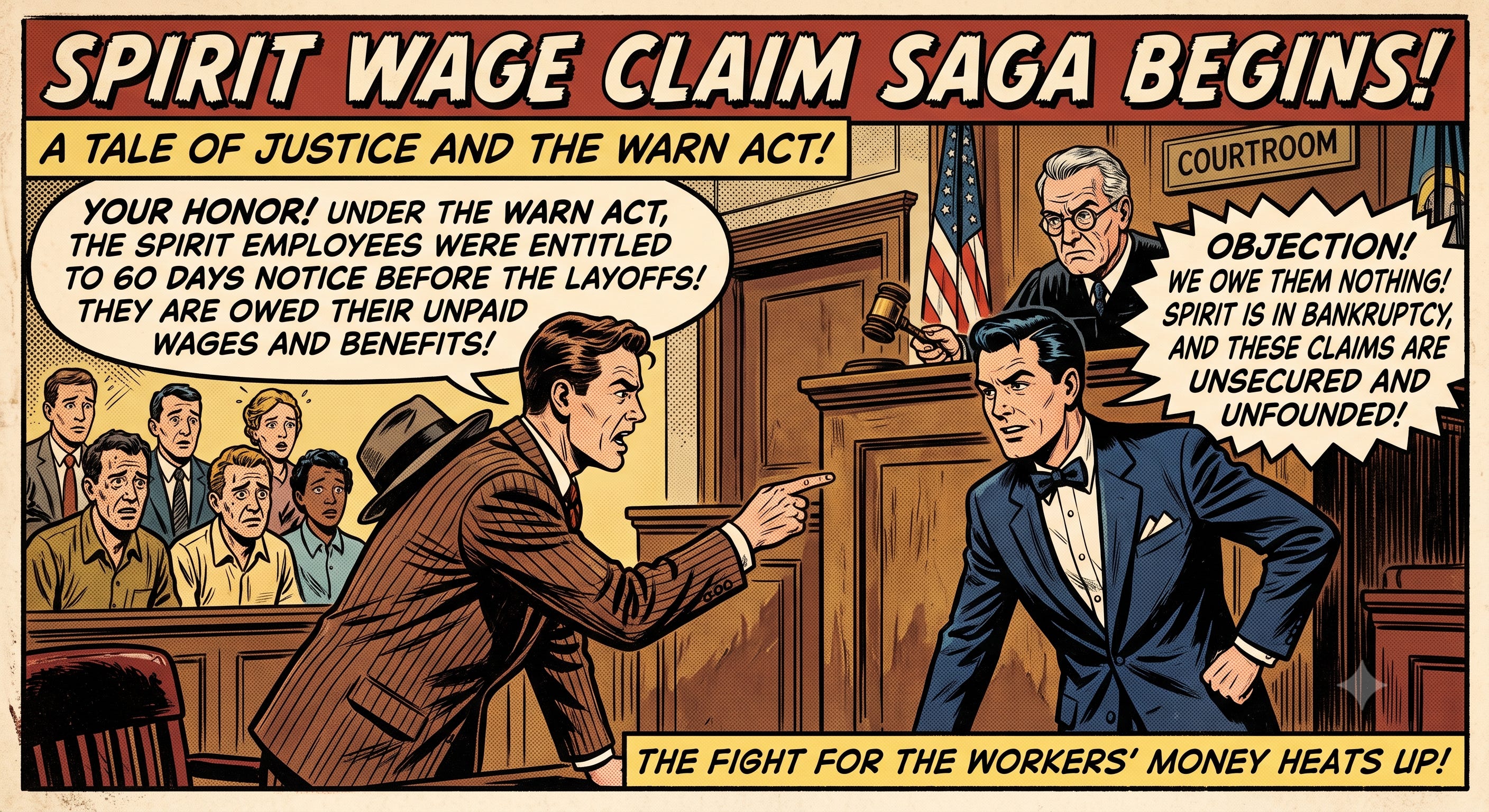
The class action — Dionne et al. v. Spirit Aviation Holdings, Inc. — was filed May 12, 2026, on behalf of the roughly 17,000 employees terminated without the 60 days’ notice required under the WARN Act. It seeks 60 days of back pay and benefits for the entire class.
Here’s what’s important for this issue: the Debtors are contesting the claim, and their defense matters.
At a June bankruptcy court hearing, Spirit’s lead restructuring counsel, Marshall Huebner of Davis Polk & Wardwell, told the court the company has “either zero or virtually no WARN Act liability.” The Debtors’ position rests on two recognized exceptions to WARN’s notice requirement:
Unforeseeable business circumstances — arguing the sudden collapse (driven in large part by an Iran-war-triggered fuel price spike and the failure of a proposed federal rescue package) was not something the company could have predicted in time to give 60 days’ notice.
The faltering company exception — which can apply when a company is actively seeking capital up until the moment operations stop.
Spirit has also indicated it will oppose class certification, a step the plaintiffs need before the case can proceed as a group action rather than a patchwork of individual claims.
We’re not going to tell you how a federal judge will rule on unforeseeability when a company was reportedly telling staff as late as April 16, 2026 that operations would continue. That’s for the court to decide, and we’ll report the outcome as it develops. But you should know going in that “we owe you nothing” is the company’s actual, stated legal position — not a worst-case hypothetical.
The $70 Million Question
This is the fight sitting underneath almost everything else right now.
When the DIP (debtor-in-possession) financing was arranged, it included a carve-out reserved for employment-related claims — capped at $80 million. The Debtors ultimately deposited approximately $70 million into segregated accounts (Docket 1164, AFA’s objection filed in June 2026, p.13 ¶6).
The problem: the Debtors and their secured lenders are taking the position, in their own words, that “no amounts will be paid on account of any values related to WARN, unused vacation or unused PTO” (originally stated in the Debtors’ Supplement to the Wind-Down Motion, Docket 1115 ¶5; contested in AFA’s objection, Docket 1164 ¶¶7, 21).
In other words: the money is sitting there, segregated and untouched, while the party that put it there argues none of it should go to the exact claims it was reportedly set aside for.
AFA has pushed back hard on this, and Judge Lane has acknowledged — without resolving — the tension. At the June 12, 2026 hearing (Docket 1233, transcript p.15), he told the parties:
“Accordingly, the Court will repeat now the view it expressed at the June 10th hearing — that employment-related claims and obligations need to be addressed as quickly as possible. Regrettably, however, we cannot make those determinations today.”
That’s about as close as we’ve gotten to a signal from the bench, and it’s not a ruling. The Debtors’ own late-July motion to extend the exclusivity period (Docket 1393, p.10 ¶27) notes that clearing the Pre-Wind Down bar date is a necessary step before the court and advisors can even “assist in the determination of the quantum of administrative claims” — meaning the actual math on how much is owed hasn’t formally started. That process is expected to move now that the bar date has passed.
We’ll keep tracking this one closely. It’s the single largest pool of money directly tied to what current and former employees are owed, and right now, nobody has a firm answer on when — or whether — it gets released.

🚨Privacy Alert: Check Your Filed Claim🚨
If you filed an individual Pre-Wind Down claim — separate from your union’s omnibus filing — this applies to you.
While reviewing my own claim on file, I noticed the Epiq claims portal doesn’t automatically redact personal information. I went and looked at what Google LLC’s claim (a corporate creditor) had on file for comparison, and the difference in what was and wasn’t exposed was noticeable.
Here’s the distinction that actually matters:
Your home address being visible on your claim is legal, and it’s not unusual. Bankruptcy filings simply aren’t protected the same way for addresses — there’s no rule requiring your home address to be redacted. If it’s on there, that’s normal, even if it’s not comfortable.
Your Social Security number is a different story.
Under Federal Rule of Bankruptcy Procedure 9037(a), only the last four digits of your SSN are permitted to appear on a public filing. A full SSN on the record is not normal — it’s the actual privacy violation here, and it’s the one worth acting on.
So: if either your SSN (in full) or your home address is on your claim and you’re not comfortable with it being public, you should amend your claim immediately. Use a PO Box or any other mailing address you’re comfortable having on the public record. If your claim is later approved, you can always update your address with Epiq by phone or email — this doesn’t need to be your permanent address.
The Fix: A Free Amendment Tool
I built a self-contained tool to help generate a clean, properly formatted supporting document for an amended claim — modeled on how much more detailed and “official” Google’s own submission looked compared to the average individual filing.
Tool link: https://jcarrington88.github.io/spirit-wage-claim-builder/
How it works:
Click “Amend Claim Form” and check the box marked “This amends a claim I already filed.”
Fill in your information — job details, dates, whether you’re represented by a union, and whether you have payroll records to back up your numbers.
Enter the amounts you’re claiming. The form calculates your totals automatically.
It generates a fully written document you can submit as a supporting attachment to your amended claim.
The tool doesn’t save or transmit any of your information — and it can run entirely offline in your browser. Once you’ve saved your generated form, log into the Epiq portal, find your Pre-Wind Down claim, and click amend. Update your address and/or SSN as needed, then upload the saved form as a supporting document.
A quick personal note: I received a number of DMs about the claim form last week and wasn’t able to respond right away. Hospital + food poisoning = J.C. out of commission for a few days. Appreciate the patience, and as always, I hope this helps. Good luck.
Court Dates to Watch
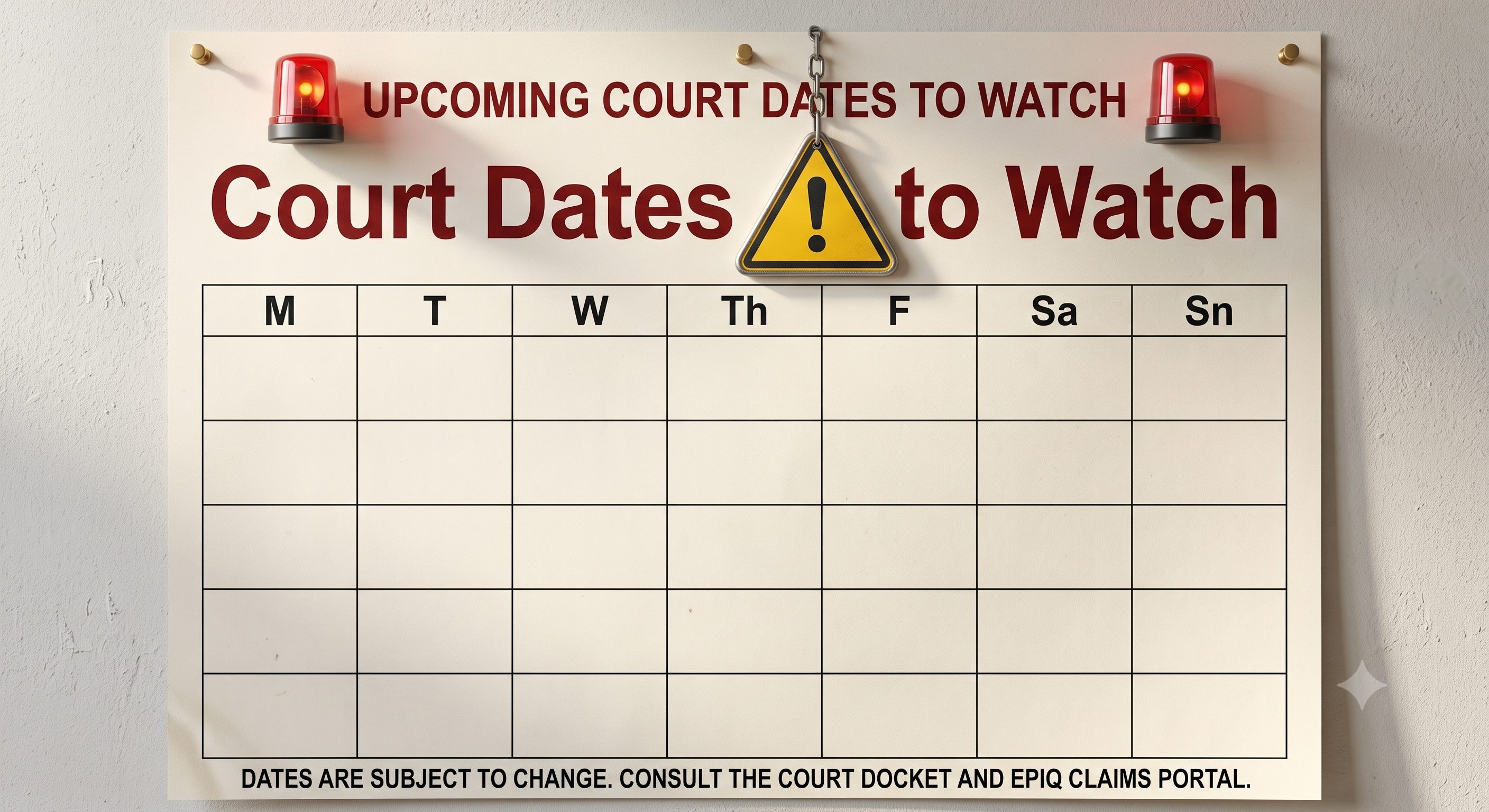
Bankruptcy hearing and deadline dates in this case have already shifted more than once — several of the dates below are themselves revisions of earlier dates that got pushed back. Confirm anything time-sensitive directly through Epiq’s case site or PACER before making travel or filing plans around it.
Aug 4, 2026, 10:00 a.m. Omnibus Hearing — Detroit Hangar termination agreement (uncontested)
Aug 7, 2026, 4:00 p.m. Dania Beach campus — final bid deadline
Aug 11, 2026, 10:00 a.m. Dania Beach campus — auction (if required)
Aug 19, 2026, 11:00 a.m. Adjourned Omnibus & Sale Hearing — campus sale approval, Honeywell Aerospace cure dispute, third interim fee applications, Harlem Park Partners IP data room motion.
Aug 27, 2026, 4:00 p.m. Aircraft (27 EETC-financed A320-family jets) — final bid deadline
Sep 9, 2026, 10:00 a.m. Aircraft auction — virtual, via Zoom
Sep 14, 2026, 4:00 p.m. Aircraft sale — objection deadline
Sep 16, 2026, 11:00 a.m. Aircraft Sale Hearing / monthly Omnibus Hearing Oct 14, 2026, 11:00 a.m. Omnibus Hearing — ongoing wind-down and administrative claims matters
The campus and aircraft dates trace to recent filings: the campus timeline was most recently revised in Docket 1410 (filed July 29, 2026); the aircraft sale runs off the Bidding Procedures Order entered July 27, 2026 (Docket 1397) and the Notice of Public Auction filed July 28, 2026 (Docket 1403).
What to Do Next? 🤔
Filed an individual claim? Check it on the Epiq portal for an exposed SSN and amend if needed, using the tool above.
Only covered by your union’s omnibus claim? Nothing to file — you’re already in the queue.
Want to track this yourself? Case dockets are searchable through Epiq’s case site; the claims agent phone line is 855-952-6606.
More next issue as the campus sale, the aircraft auction, and the $70 million fight all move through hearings this August and September. Stay tuned.
— The Unpaid Employee | www.spiritdidnotpayme.com