Google Wants Your Data and, so Does Everyone Else…
On August 14, Google won a bankruptcy auction for a chunk of Spirit Airlines that has nothing to do with planes or gates: 100 million employee emails, 500 million Microsoft Teams messages, 30 million lines of code, and years of internal business records — all for $10 million. Google beat out Mercor, an AI data company valued at $10 billion, to get it. This isn’t a footnote to the wind-down. It’s the sale of the digital exhaust of 17,000 people’s working lives, and it almost went through without most of you ever hearing about it.
It didn’t, because the Association of Flight Attendants filed a Limited Objection on August 17 (ECF 1489) sharp enough that the court delayed the approval hearing — originally set for August 19 — to September 9.
Here’s the part that should make you pay attention, even if you’re not a flight attendant:
AFA’s objection points out something the sale’s own paperwork gives away: nearly all consumer-facing data — traveler profiles, loyalty records, call recordings — is marked “Not Included” in this sale. Nearly all employee-facing data — time cards, payroll, tax forms, training and disciplinary records, internal Teams messages — is marked “Included.” The privacy protections built into this deal were designed with passengers in mind.
Employees are the ones actually being sold!
Spirit says the data will be “deidentified.” AFA’s objection makes a sharper point than “we don’t trust that”: deidentification only addresses whether a record can be traced back to a name. It does nothing about whether the contents of that record — a disciplinary write-up, a medical accommodation request, a private Teams message — are still sensitive on their own, name or no name attached.
And there’s a technical problem underneath that. The sale agreement requires deidentification to preserve “referential integrity across the data set” — meaning the links between records (which timecard connects to which pairing, which payroll entry, which message thread) have to stay intact. Spirit’s flight attendant workforce is about 4,600 people. AFA’s argument: in a population that specific, keeping those links intact makes it realistically possible to reconstruct who a “deidentified” record actually belonged to, even without a name on it. That’s not a hypothetical fear — it’s a well-known, real limitation of how deidentification works on this kind of data.
AFA isn’t asking the court to kill the sale outright, though. Their ask: exclude flight attendant data entirely, or require a real segregation and review protocol, screening of free-form messages, and a contractual ban on using the data to profile individual crew members or subgroups.
Credit where it’s due — and a question worth asking out loud.
AFA’s objection here is exactly what a union should be doing: reading the fine print, catching the employee/consumer split, and putting a specific, real legal argument on the record before a sale most people would never have known about. That’s the kind of representation people should expect and deserve — full stop.
But it raises an obvious question we haven’t seen answered anywhere:
Where is everyone else???
As of this filing, we haven’t found a matching objection from ALPA, IAM, TWU, or PAFCA — and it’s worth asking why, since pilots, dispatchers, and ground crew almost certainly have records inside this same dataset too. If you’re a member of one of those unions and know something we don’t, we’d genuinely like to hear it.
And zoom out further, because this part should bother everyone regardless of which worker group you belonged to: thousands of people who worked for this company are still owed their last paychecks, and the estate is currently finding buyers for their private records for $10 million while that debt sits unpaid.
Whatever legal machinery keeps “the wage fight” and “the asset sale” filed as two separate processes, they are not two separate stories to the people living through both at once. The same estate that says it can’t pay you what you’re owed is actively profiting off CONFIDENTIAL information about you.
Sit with that.
This Has Happened Before — And the Most Recent Case Is a Warning
If you’re wondering how any of this is legal, you’re not alone, and there’s a real paper trail here worth knowing.
Toysmart (2000) is the case that started it all. A bankrupt children’s toy retailer tried to auction customer data despite a privacy policy promising it would “never” be shared. The FTC sued. The settlement got so much pushback from state attorneys general that the company eventually withdrew the data from sale entirely. Congress took notice — in 2005, it created the Consumer Privacy Ombudsman requirement specifically because of this case, the exact legal mechanism now sitting in Spirit’s docket (Docket 1446, filed August 12).
That produced a standard test — sometimes called the “Toysmart conditions” — later applied in RadioShack (2015, ~117 million customer records) and Borders (2011): data shouldn’t be sold as a standalone asset, the buyer should be in a similar line of business, and the buyer should have to honor the original privacy policy.
Google is not in the same line of business as an airline, and this is a standalone data sale.
Historically, that combination is exactly what draws regulatory intervention.
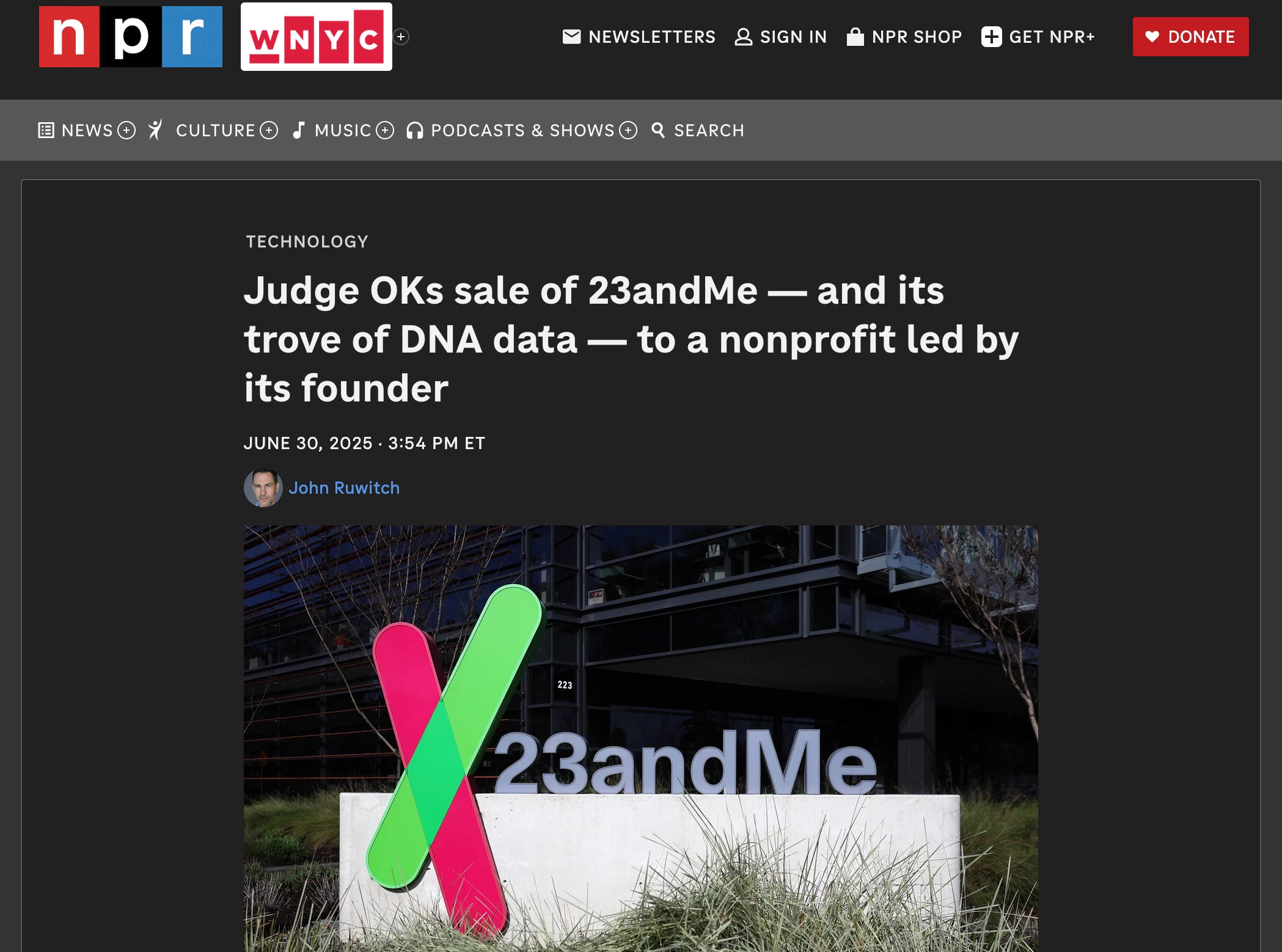
The case that should worry you most, though, is the most recent one. 23andMe filed for bankruptcy in March 2025 and sold the genetic data of 15 million people. The court-appointed privacy ombudsman wrote a 200-plus-page report and concluded he “cannot conclude that certain non-bankruptcy laws would not be violated” without fresh consumer consent. More than 30 state attorneys general objected. The court approved the sale anyway. The lesson for Spirit’s case: a strong objection from a privacy ombudsman, or from an army of state AGs, does not mean a sale gets blocked. The Ombudsman’s role is required input, not a veto. Whatever happens September 9 will happen inside that same reality.
A Pattern We’ve Seen Before, From Inside This Campaign
This isn’t the first time someone’s tried to get their hands on Spirit-related personal information under false pretenses. Earlier this year, a scammer impersonating the CEO of another airline, tied to what’s now confirmed as the Mooney International scam, created a fraudulent website claiming to be an interested buyer for Spirit Airlines — and used that pretext to collect data. We reported on it at the time; the site involved has since been taken down. The pattern is the same one running through this entire issue: whether it’s a scammer using a fake acquisition story or a $10 billion AI company legitimately winning a bankruptcy auction, proprietary data — especially data tied to thousands of real people’s working lives — has become something worth lying, scamming, and litigating over.
Be guarded accordingly, on every front, not just the ones that show up in a court filing.

Also Worth Watching: Credibility Issues wit the Ameer Flippin Aircraft Bid
Ameer Flippin, the pro se litigant behind Harlem Park Partners’ aircraft bid, hit a real procedural wall this month. Corporations legally cannot represent themselves in federal court without a licensed attorney — a rule his filings ran straight into. On August 18, he filed a personal affidavit attempting to recharacterize his prior filings as submitted in his individual capacity rather than the corporation’s, arguing the company was simply “a vehicle to execute transactions in his personal interest.” That affidavit also included a series of extremely …interesting… personal claims well outside the normal scope of a bankruptcy filing.
The court is set to formally address the status of his filings at the August 19 omnibus hearing.

Bottom Line
Watch September 9 — that hearing will tell us a lot about how much protection any of this actually offers. And keep being skeptical of anyone, scammer or Fortune 500 company, who comes asking for information tied to your name, your work, or your life at Spirit.
— The Unpaid Employee | spiritdidnotpayme.com