September 9 was supposed to be the day the data sale got decided. It wasn’t — but the week around it produced three fights worth knowing about: a Consumer Privacy Ombudsman report that adds a third bidder to the mix, a severance fund quietly headed to the DIP Lenders instead of you, and the real story behind Ameer Flippin’s dismissed appeal.
The CPO Report Landed — And Now There Are Three Bidders, Not Two
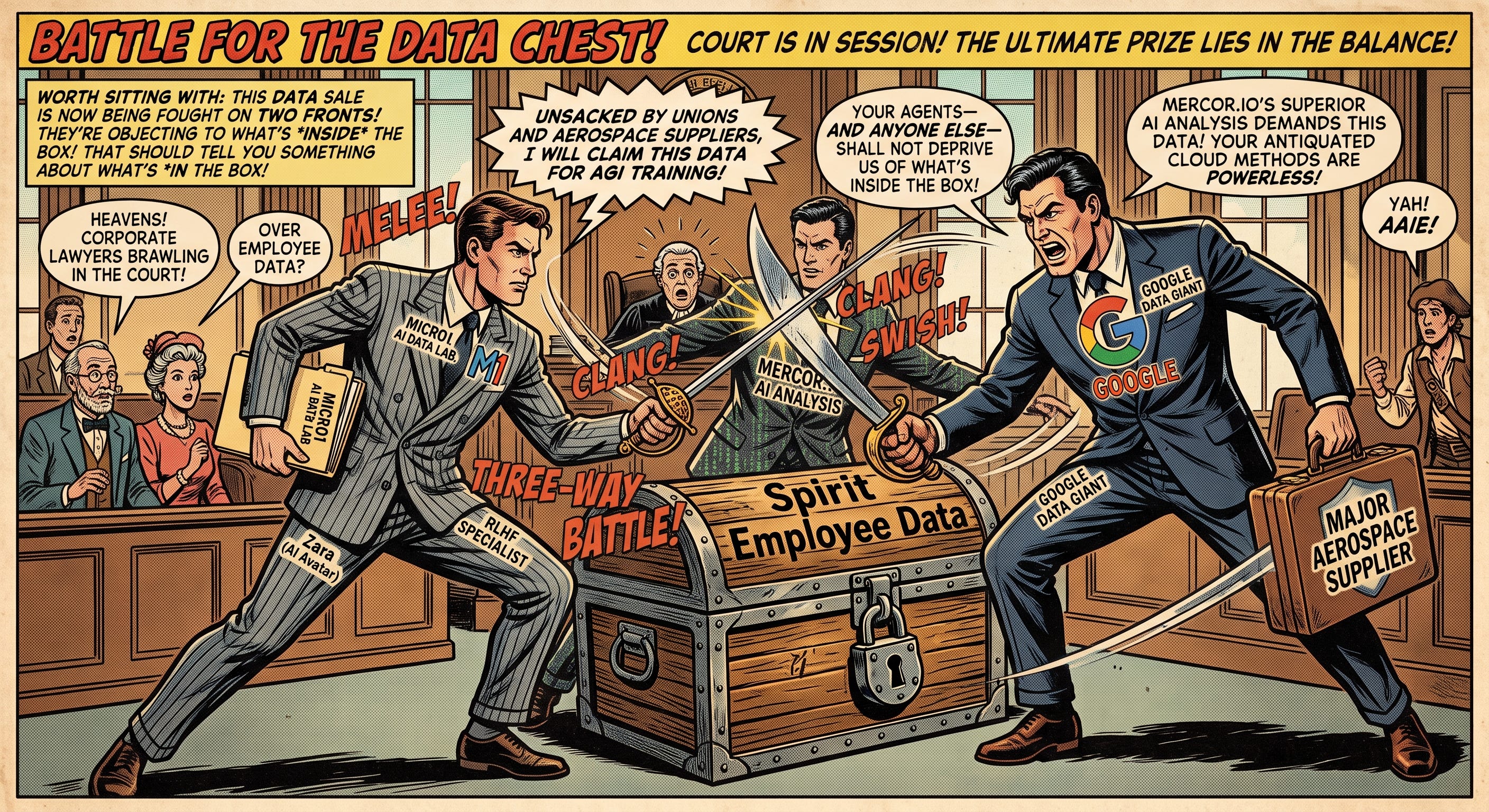
On September 8, Consumer Privacy Ombudsman Lucy L. Thomson filed her formal report on the Deidentified Data sale (Dkt. No. 1581). We’ve been covering this as a two-way race — Google’s $10 million win versus micro1’s $12.5 million late bid. Thomson’s report makes it three-way: Google as the “Successful Bidder,” Mercor.io — the firm Google beat at the original auction — still standing as the “Alternate Bidder” at $7.5 million, and micro1 trying to unseat both.
The detail we hadn’t seen before.
Buried in the report: Mercor.io “experienced a supply chain security incident” earlier this year, per the company’s own public writeup, which the CPO cites in a footnote (Dkt. No. 1581 at 3). That’s a flag for further vetting, not a finding — but if this ends with your old emails going to whichever bidder got the least scrutiny, it’s worth knowing now rather than after.
The most lethal line in the entire argument. The report quotes Spirit’s own privacy policy against the company:
“Sale of Information. We do not sell personal information.” (Dkt. No. 1581 at 11)
The CPO argues the sale sits in tension with that language. Google disagrees, and said so the next day.
Google’s pushback.
On September 9, Google filed its formal response (Dkt. No. 1594), confirming it had already agreed to drop several data categories — PNR/transaction records, refunds, inflight purchases, timecards, WiFi sales — before the CPO report was even filed. But Google disputed how the CPO characterized that move, calling it not an attempt to reduce reidentification risk but “a means of excluding datasets that may contain Consumer Data from the scope of the transaction altogether” (Dkt. No. 1594).
Worth sitting with: AFA’s original objection was never about consumer data — it was about employee data, payroll, disciplinary records, internal messages.
Google’s carve-outs are about consumer data. Whether they touch the actual union concern is still an open question.
What’s next. The new hearing date, per the amended agenda (Dkt. No. 1577): September 16, 11:00 a.m.
$58 Million Meant for Severance Is Headed to the DIP Lenders
This is the one we think matters most, and it turned up by accident — while we were chasing down a different citation.
When the DIP financing was approved, the court walled off a segregated account — the “Administrative Claim Carve Out (B),” funded at $70 million under an $80 million cap (Dkt. No. 1022/1048) — to cover severance-type “Separation Obligations” for laid-off employees. The reason: unpaid severance could create personal liability for Spirit’s officers and directors under state law.
What happened this week.
On September 9, the Official Committee of Unsecured Creditors (Willkie Farr & Gallagher) filed a statement (Dkt. No. 1592) on the Debtors’ motion to release roughly $58 million of what’s left in that account — to the DIP Lenders.
Read that twice.
The money set aside because not paying it could create personal legal exposure for Spirit’s executives is now headed to the lenders who financed the bankruptcy — not to the employees the account exists to protect.
The Caveat that Could Speed-up or Slow down the Process.
The Committee’s statement flags that non-union former employees, and their potential personal-liability claims, may not be fully resolved by releasing the funds now — and it “encourages the Debtors and the DIP Lenders to engage with the employee unions and non-union former employees ... to resolve the Motion on a consensual basis” (Dkt. No. 1592).
The Part that Matters to Non-Union Employees.
The Carve-Out (B) definition doesn't name unions at all — it covers amounts owed to any employee on separation that would create personal liability for a Spirit officer or director if left unpaid (Dkt. No. 1022 ¶13(j)). But nothing about qualifying for it is automatic: the Debtors decide which claims fit that definition in consultation with the DIP Lenders, who can force a court hearing before anything gets paid (Dkt. No. 1022 ¶13(k)). Union claims get pressed by lawyers who are already sitting in on that consultation. If you're a non-union former employee owed severance, the process is the same as anyone's — file a Proof of Claim (Official Form 410) with Epiq, the claims agent — but you'll also need to show why not paying you specifically would expose a Spirit officer to personal liability under your state's wage law, since that's the actual legal test, not union membership. We're not lawyers and this isn't legal advice; an employment attorney can tell you where you actually stand.
Ameer Flippin’s Appeal Just Died — Not Over What You’d Think
Quick update on a thread from issue 009: Flippin’s August scramble to stop the aircraft auction and save his EETC bid. On September 4 (signed the 3rd), Judge Jesse M. Furman dismissed his appeal (Case No. 26-CV-7277, Dkt. No. 1561).
Here’s the part worth getting right: this wasn’t about the auction or his bid. Flippin, pro se, was appealing a bankruptcy-court ruling that restricted his own filings in the case. Furman found no “substantial ground for difference of opinion” on that question, denied leave, and closed the case.
What it doesn’t tell us: whether his actual motions to stay the auction succeeded. Separate thread, still open. The aircraft auction itself was also adjourned this week (Dkt. No. 1582) — that’s the Debtors’ notice, unrelated to Flippin’s appeal.
Upcoming Court Dates
September 16, 2026, 11:00 a.m. — Sale Hearing on the Deidentified Data: Google vs. micro1 vs. Mercor.io, before Judge Sean H. Lane.
DIP Carve-Out (B) enforcement motion — the Committee’s statement (Dkt. No. 1592) is in; no hearing date set yet. Working on tracking down when this gets its day in court.
Ameer Flippin’s appeal — closed. Case No. 26-CV-7277, dismissed September 4.
Three fights, one theme this week: watch who’s actually in the room when the money gets decided.
— The Unpaid Employee | spiritdidnotpayme.com